Inclusion
Short Description
This session will start a discussion about different social groups and their treatment in society. The session will start with an activity where someone is left out and a discussion will follow on inclusion, exclusion and different ways in which people and groups can be included or excluded. Inclusion examples from Malta will be shared and discussed and the importance of inclusion is discussed.
Estimated Activity Duration: 40 – 55 minutes
Recommended Ages: 10-18
Aims of Workshop
- To start discussion about different groups and their treatment in society
- To introduce the concepts of prejudice and discrimination
- To encourage empathy with discriminated groups or persons
- To learn to actively be inclusive through language

Competences and Knowledge required
Materials Needed
- Screen, projector or Interactive Whiteboard
- 4 Scenarios Graphic & Explanations (See Resources Section)
- Inclusion Stories (See Resources Section)
Learning Outcomes
- Social Studies
- Year 9 Option – Cultures and Identities
- I can explain the advantages of cultural diversity in different environments.
- Year 11 Option
- I can explain different types of migration and what is being done in different countries, including Malta, to integrate migrants into society.
- Year 9 Option – Cultures and Identities
- PSCD (Level 7) – Citizenship
- I can recognise the importance of different national, religious and ethnic groups and which of them are reflected in my school community.
- Geography: Level 8 – Natural and Human Environment through the Use of Scientific Method and Qualitative and Quantitative Research.
- I can research a case-study of a particular receiving country to evaluate the positive measures taken to integrate the migrants.
- Cross-curricular themes addressed:
- Learning to learn
- Education for Diversity
Outlines of the session, including detailed description of the activities carried out
Odd One Out (5 min.):
Before the start of this session, the educator will email or in one way or another assign each student one of three colours. Yellow, Orange and Brown. Only one student should be given the colour Orange.
The educator explains that now the different groups, staying in their place if in classroom and via chat if on an online platform, have to find their members. (In a no social restriction context, this would be done by mingling, and non-verbal communication). The names of the students for each of the three groups are written down.
Note: Should comments be passed especially on the colour ‘brown’ these comments can be used further in the discussion on inclusion.
Debriefing and Discussion (10 min.):
After the names of students forming part of the three groups are written, a short discussion follows. Students are asked some of the following:
- How do you feel now? (popcorn method, one or few words each)
- How did you feel when you realised that you were part of a group? How did you feel originally at the start when you realised there were other people with your colour?
- How did you, as the person with the odd colour feel?
- What different groups do you belong to in society (e.g. Sports, religious, drama, dance, school etc)? (These should be written down on the interactive whiteboard or a document that is screen shared)
- Can anyone join these groups that you are part of?
- Would it have been more fun if different colours could have joined together to form a group? Everyone would have had a group even if different.
Note: Should you as an educator think there will not be enough time for a whole discussion, it can be replaced by ‘Have you ever been excluded from something? How do you usually feel when you are excluded?’ and some students answer.
Separation, Exclusion, Integration, Inclusion (15 min.):
The students are told that in order to understand Inclusion, we must also understand the other processes where multiple groups coexist in a society.
Firstly, a definition of ‘society’ is gathered from the students. Then 4 processes are mentioned: Exclusion, Separation, Integration and Inclusion. Students should try to explain what they think the 4 mean.
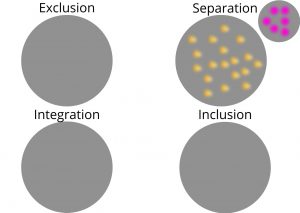
To do this, the educator screen shares, projects or draws the following (‘Exclusion Separation Integration Inclusion to use during Lesson’ found in the resources section)
The big grey circles are society, the different coloured dots are people. The yellow are Maltese people and the purple non-Maltese. Separation is given as an example. The students should, on their own, draw the above on a paper and try to guess where the Maltese and non-Maltese people would be placed in the other 3 scenarios.
Note: The educator can also add more groups rather than just 2. For this, an editable canva graphic link is placed in the resources section below (search for ‘dot’ in elements for the dots).
After the students have finished (10 minutes), some students should be prompted to share and show what they think and why.
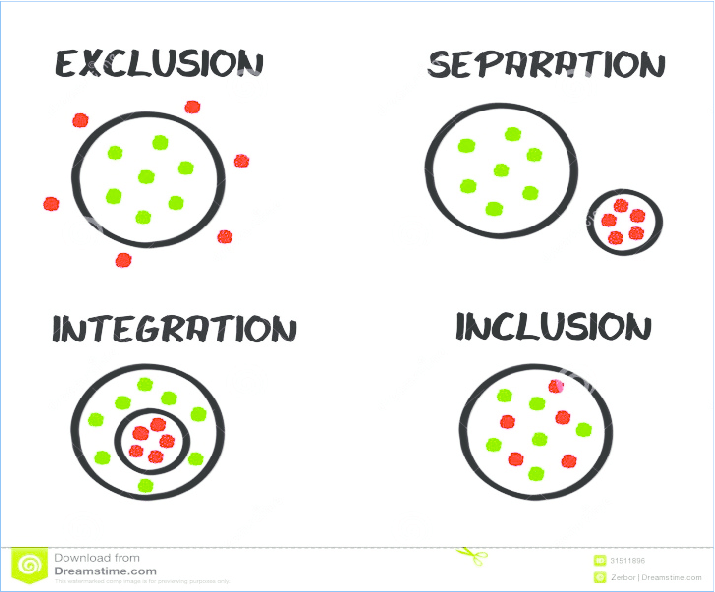 With the use of the graphic on the left (‘IISE to project after students brainstorm.jpeg’ in the resources section), the trainer explains separation, exclusion, integration, inclusion in society.
(Explain also that separation is called segregation sometimes and that Inclusion is sometimes referred to as Integration in the media, the context in which it is used should give an indication if they mean ‘Integration’ or ‘Inclusion’ as we will see in the next section, these two concepts are different)
If the educator wishes or the students ask if you can go from one process to the other, this graphic (‘Separation-to-Exclusion-to-Integration-to-Inclusion’ in the resources section) can be shown

Although the process is not always linear and like this, it can happen.
Inclusion Discussion and Stories (25 min.):
Now that the students have an idea of the 4 scenarios, a discussion on inclusion will take place.
The educator should first start by asking if ‘Is everyone is included in Malta. Who is included? Who is excluded?’ A list can be made. Some prompts can be given if students are not comfortable sharing such as:
Would a male forced (explained that this was a movement that was not voluntary but that they had to) migrant from Eritrea be included?
Would a male voluntary migrant from Libya be included?
Would a female mother forced migrant from Somalia with two small children be included?
Facilitation note: Since identities are intersectional, it could be that the student will mention other identities such as someone who is bisexual, transgender or has a disability. These identities are important but should be combined with nationalities, ethnicities and citizenship status i.e. Would a lesbian forced migrant from Bangladesh be included? Since the session is about inclusion of Migrants.
The educator then asks the students if they know of integration stories in Malta and to mention them if they know.
If students do not have examples, some of the examples below can be shared and read. In the drive there are: The Senegalese Flower Seller and the Humans of Malta stories (found in ‘Inclusion Stories Resources’ folder) and linked below are the ‘1 Run videos’ (see links). (Humans of Malta as a concept can be introduced should the students have facebook as it humanises people.)
After some examples are given, the educator should direct the discussion on why inclusion is important by asking ‘Why do you think Inclusion is important?’
Note: If students only mention why it’s important for one group, direct the discussion also to other groups eg. locals, other migrants etc.
After some answers, the educator then concludes the discussion by asking the question ‘How can we be inclusive?’ (eg. by not excluding people from our groups, by thinking of the needs of other groups, by using appropriate language, befriending different people, by exchanging cultural practices with people from other nations etc.)
Acknowledgement
‘Odd one out’ is adapted from The European “Boogie Man” complex challenging antigypsyism through non-formal education and educational toolkit by Phiren Amenca, Roman Youth Action Plan and the Council of Europe